
Designing for the Dark Sky
How a lighting scheme proves that it will not take the night away.
A working method from LUCID Consulting Group, used on public realm and landscape projects across MENA and Europe.
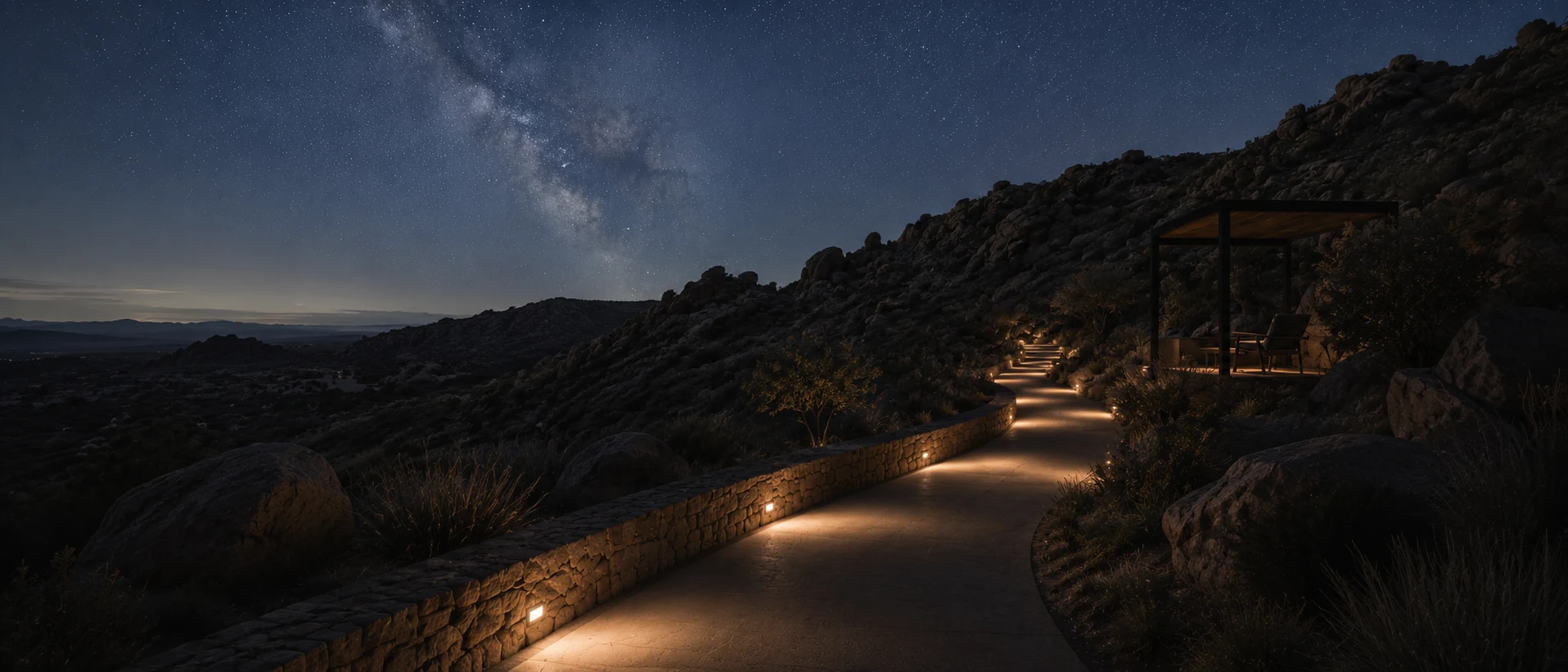
Dark sky requirements arrive as numbers, not as adjectives.
Requirements to limit light pollution reach a project by two routes. In MENA they are written into the documents of the project itself, through an authority manual or a destination design manual issued for a masterplan. In Europe they arrive from outside, through national and regional law that changes at every border.
Either way they have to be met on the drawing rather than described in a covering letter. What follows is the part of the handbook that settles the most arguments: the names of the three problems, the quantity that measures each one, and the rules that follow from those quantities.
Three failures, and a different quantity for each.
Light pollution is the everyday term. In the standards it resolves into measurable components, referred to collectively as obtrusive light, and it is those components that carry parameters and limit values. Dark sky work is often reduced to buying shielded fittings. That covers one part of one failure. A design only holds up when each failure is controlled separately and checked against the quantity that actually governs it. ILP counts four categories of obtrusive light, separating spill light from nuisance at the receptor; that is the same physics measured in a different place, so we keep three.
Glare
Light leaving the luminaire at high angles, straight into the eye. It destroys dark adaptation, which matters more on a rural or coastal site than anywhere else. Measured by: luminous intensity in candelas toward the observer, limited by zone and by viewing distance. In zone E0 the limit is zero, which only a luminaire with complete cut-off in those directions can deliver.
Spill light and nuisance
Light that leaves the task area or reaches a window it was never meant to reach. Measured by: vertical illuminance at the window, taken as the sum of all installations rather than yours alone. On terminology: ILP has retired “light trespass” on the grounds that light cannot trespass; the current terms are spill light and nuisance.
Sky glow
Light emitted or reflected upward and scattered by dust and water vapour. Measured by: upward light ratio (ULR) for a single luminaire, and upward flux ratio (UFR) for the installation, which also counts light reflected off the ground.
The darker the site, the tighter the limits.
In a city an installation sits inside an already bright environment. On a plateau, a desert site or an undeveloped coast there is almost no background light, and the same luminaire becomes the brightest point on the horizon. The tables show the scale of it: permitted upward light rises from zero in zones E0 and E1 to 15% in E4, and permitted illuminance at a neighbour window from 2 lx to 25 lx. That is a step change, not a gradient, which is why the zone has to be settled before the concept rather than after it.
| Parameter | E0 | E1 | E2 | E3 | E4 |
|---|---|---|---|---|---|
| ULR | 0 | 0 | 2.5 | 5 | 15 |
Counts direct emission only. CIE 150 states at this table that it does not account for light reflected off the ground, which also adds to sky glow.
| Installation | E0 | E1 | E2 | E3 | E4 |
|---|---|---|---|---|---|
| Road | — | 2 | 5 | 8 | 12 |
| Amenity | — | — | 6 | 12 | 35 |
| Sports | — | — | 2 | 6 | 15 |
Direct and reflected components together. This is not an automatic test of every installation of four luminaires. GN01/21 applies it to installations with a defined performance requirement that sit near an optical observatory, or in an E1 zone abutting a protected E0 zone. A dash means an installation of that type is not normally expected in that zone.
| Condition | E0 | E1 | E2 | E3 | E4 |
|---|---|---|---|---|---|
| Pre-curfew | — | 2 | 5 | 10 | 25 |
| Post-curfew | — | <0.1 | 1 | 2 | 5 |
The figure applies to the sum of every installation visible from that window, not to yours alone. In E1 the post-curfew limit may rise to 1 lx where the installation is public road lighting.
| Surface | E0 | E1 | E2 | E3 | E4 |
|---|---|---|---|---|---|
| Building facade | <0.1 | <0.1 | 5 | 10 | 25 |
| Sign | <0.1 | 50 | 400 | 800 | 1000 |
Taken as average illuminance multiplied by reflectance and divided by π. In zones E0 and E1 both values fall to zero after curfew — facade and sign lighting goes off rather than dims.
These are two different zone systems. E0–E4 come from CIE 150 and European law is built on them. LZ0–LZ4 come from the Model Lighting Ordinance, which reaches its limits through its own zones and the BUG classification of backlight, uplight and glare, together with a total site lumen allowance, rather than through a single upward-light percentage. The two systems are not interchangeable and their parameters are not equivalent. The criteria sheet has to state which system it runs on and hold to it through to closeout.
Two rules that are easy to trip over. Where a site lies close to the boundary between two zones, the limits of the stricter zone apply. And zone E0 must always be surrounded by an E1 zone, so an observatory or a reserve core carries a buffer that is itself a design constraint.
Near an observatory a further limit applies just above the horizontal. Luminous intensity below 2.0 cd per 1000 lm between 80° and 90°, below 0.5 cd between 90° and 100°, and zero from 100°. Verifying it needs photometry measured across the full gamma range from 0 to 180°, which is not always supplied — ask for it while the product shortlist is being built, not at submittal review.
Nine rules that follow from those quantities.
The order of operations is settled and shared by the IES and DarkSky: light should be useful, targeted, at the lowest level that works, controlled, and warm in colour. Below is the same thing, translated into decisions that get made on the drawing. This is our editorial grouping; the handbook itself sets it out as a chapter of eight controls applied in order.
Zone first, concept second
The limits are a function of the environmental zone, not the other way around. ILP GN01/21 adds two rules that are easy to miss: near the boundary between two zones the stricter one applies, and zone E0 must always be surrounded by an E1 zone. The zone is usually settled in the first week, by someone who is not a lighting designer.
Zero means zero
The share of luminaire flux emitted above the horizontal is 0% in zones E0 and E1, 2.5% in E2, 5% in E3 and 15% in E4. The Model Lighting Ordinance reaches the same outcome by a different route, through its own LZ0 to LZ4 zones and the BUG classification of backlight, uplight and glare, rather than through a single percentage. On a dark site there is no budget for uplight.
Nothing is aimed at planting
Planting and tree canopies should read by light reflected off the ground plane, not from fittings of their own. A luminaire aimed at a shrub or a tree emits flux above the horizontal and lights a habitat at the same time. ILP GN08/23, produced with the Bat Conservation Trust, requires dark corridors and dark foraging habitat. This is a rule, not an aesthetic preference.
Dark corridors stay dark
Where the site adjoins woodland, a tree line, a watercourse or a shoreline, the continuity of unlit routes is a design object in its own right. It is agreed with the ecologist before the layout is drawn, shown as an unlit zone, and defended in the same way as any other criterion. This is the one ecological requirement that changes the arrangement of the scheme rather than the specification of its parts.
Reflected light reaches the sky too
The ULR table counts direct emission only, and CIE 150 says so explicitly: it does not account for light reflected off the ground, which also adds to sky glow. Hence a separate measure for installations of four luminaires or more, the upward flux ratio, which sums the direct and the reflected component. For amenity lighting that is 6% in E2, 12% in E3 and 35% in E4, while for zones E0 and E1 the table does not contemplate such an installation at all. The quantity of light you put on the ground is a budget, not a side effect.
Facades and signs are a luminance limit
The limit is not placed on illuminance but on surface brightness: average illuminance times reflectance, divided by π. For a facade that is below 0.1 cd/m² in E0 and E1, 5 in E2, 10 in E3 and 25 in E4. In zones E0 and E1 the value drops to zero after curfew, which means facade lighting simply goes off.
Nuisance is measured at the neighbour window
Vertical illuminance at the window: 2 lx in E1, 5 in E2, 10 in E3 and 25 in E4 before curfew; below 0.1 lx, then 1, 2 and 5 respectively after it. The limit applies to the sum of every installation visible from that window, not only to yours, which means the neighbours have to be calculated rather than assumed.
The curfew hour is part of the design
The hour after which stricter requirements apply is often a planning condition; in practice it starts between 21:00 and 23:00 and runs until 07:00. A dark sky design is a time-based design: it promises that at a given hour the installation will behave differently than it did at dusk. That promise needs a control system that reports what it actually did.
Colour is a parameter, not a preference
DarkSky Approved criteria set a nominal correlated colour temperature of no more than 3000 K for many luminaire categories, and the responsible lighting principles ask for the short-wavelength content to be limited further. Blue-rich light scatters more in the atmosphere, so the same lumen count produces more sky glow. On ecologically sensitive sites the colour temperature and the spectral distribution should follow the requirements of the habitat and the ecological assessment rather than a single universal figure.
Where the numbers come from, and where the table stops. The CIE 150 thresholds are not the product of ecological research. They trace back to Dutch work on lighting nuisance in the 1990s, reached CIE 150:2003 through the NSVV guidance of 1998, and the values for zones E1 and E4 were expert extrapolation rather than measurement. They are built around human vision and around light sources no longer in use. Where habitat is in play, the local code and the ecological assessment take precedence over the table.
Sources for these rules: CIE 150:2017 · CIE 126:1997 · ILP GN01/21 · ILP GN08/23 (with the Bat Conservation Trust) · IDA–IES Model Lighting Ordinance and IES TM-15 (BUG) · DarkSky Approved · Five Principles for Responsible Outdoor Lighting (IES and DarkSky).
Compliance is calculated, not claimed.
Calculated in the same model as the design, in a separate obtrusive light scene. Two states are always reported, evening operation and post-curfew, required value against achieved value, per limit and per zone, on the drawing rather than in a covering letter.
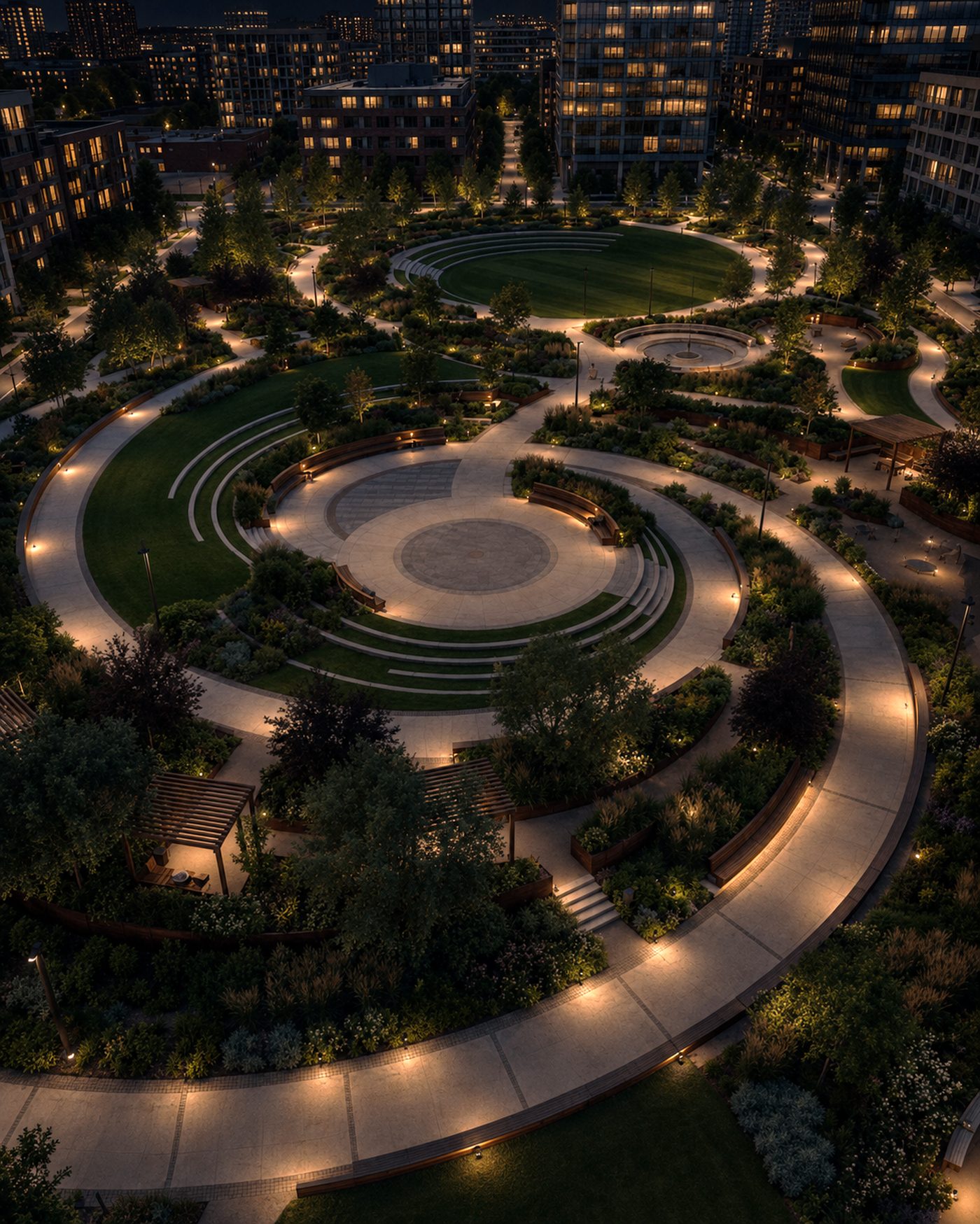
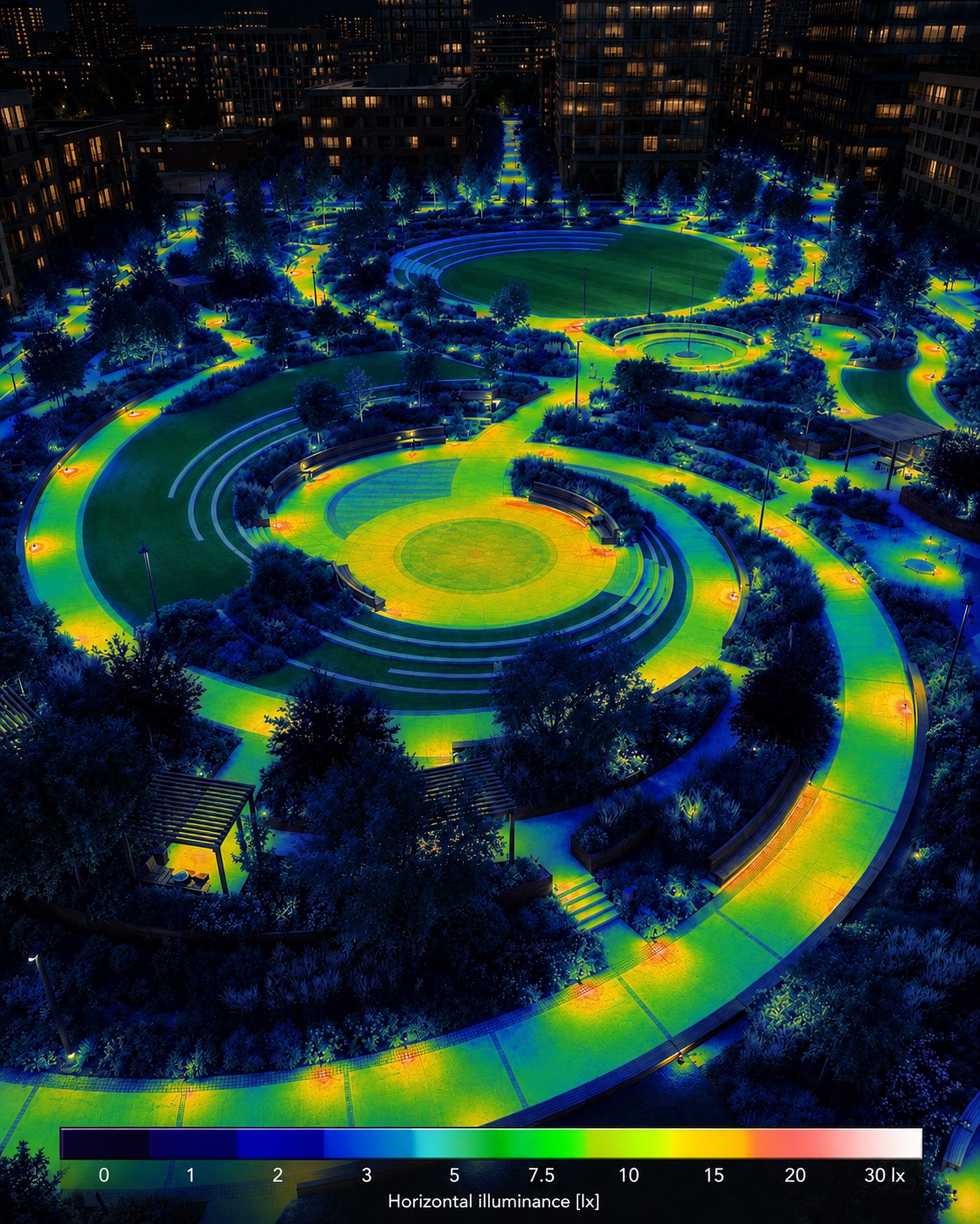
Twenty-two sections, thirty-three pages.
The regulatory map, the zone limit tables, the controls in the order we apply them, the proof, and the clauses that belong in a brief so the requirement is priced rather than assumed.
- Why the night sky became a design constraint
- The regulatory map: MENA
- The regulatory map: Europe
- Three failures, three different fixes
- The standards we design to
- What each site can carry
- What the zone actually allows
- Eight controls, applied in order
- Control, curfew and the management system
- Active lighting management
- Verification
- What compliance looks like in numbers
- What it costs to find out late
- Six things people get wrong
- Restraint is the design
- Selected work
- Deliverables by stage
- How to brief a lighting consultant
- Twelve questions before you sign off
- The same method, other constraints
- Glossary
- About LUCID
- Work with us
Written for the people who approve this work, not those who produce it.
Architects and landscape architects carrying a dark sky condition through planning. Developers and destination owners who promised the night sky in a brochure. Lead consultants who need to know what a compliant lighting package contains. Project managers who have to price the requirement rather than assume it.
You do not need to be a lighting designer to use it. The handbook sets out the questions worth asking in a meeting and the clauses that belong in a brief.
Designing for the Dark Sky
The regulatory map for MENA and Europe, the three failure modes, the eight controls applied in order and the compliance table. If it saves you one late redesign, it has paid for itself several times over.
Before you ask.
Does the handbook replace the approvals process?
No. It sets out what authorities typically require and in what form, so you arrive at approvals with the material already prepared rather than trying to work around them. Where a local code applies, it takes precedence over anything recommended here.
Does light reflected off the ground count as well?
Yes, and it is the most commonly skipped part of the job. The ULR table describes only the flux leaving the luminaire above the horizontal. Reflection from paving, planting and water is additional, and for installations of four luminaires or more it is checked with the upward flux ratio. Swapping fittings for shielded ones does not close the question if the light level on the ground stays the same.
Do you work outside MENA?
Yes. Europe is covered in the same detail, because the law there is national and regional rather than European. There is no single directive on obtrusive light, which surprises people. What there is instead is binding law in France, Slovenia, Croatia, Spain and most Italian regions, with real numbers in it.
Can you help on our project?
Usually the fastest way to find out is the brief clauses in the last section. If those are answered, one call is enough to tell whether you have a dark sky problem or a briefing problem. Most of the time it is the second one.
Three dark sky materials. Where to start explains how the field is put together. The design manual sets out the sequence of work step by step. This page is the handbook itself, with the regulatory maps and a worked example.