
Independent Signage & Wayfinding Consulting
Lucid is a Signage and Wayfinding consulting practice — not a signage supplier and not a graphic studio. We work on the layer of decisions behind the visible system: topology studies, signage matrix programmes, carrier engineering, BIM family creation, tender documentation and optional site supervision.
The work is BIM-first. We model carriers in Revit, create our own BIM families when manufacturer files are unavailable, distribute them into the client’s model and prepare STEP / IFC / RFA artefacts for coordination and fabrication. Bilingual and bidirectional layouts (EN / AR), heritage-context constraints and GCC cultural literacy are part of the discipline, not an afterthought.
Wayfinding is decision architecture.
Routes before signs. Logic before medium.
Decision before sign
Every spatial node is first analysed as a user decision point. The sign appears at the end of the process — as an answer, not as the starting point.
User perspective
Every decision is checked from the perspective of a user entering the space for the first time: without knowledge of the building, organisational shortcuts or the designer’s intent.
System over object
We design information architecture, not individual boards. Each carrier is part of a system: routes, decisions, messages and delivery standards.
From spatial logic to BIM-coordinated implementation.
Complete Signage and Wayfinding consulting for complex architectural environments — strategy, signage families, carriers, BIM components and production-ready documentation.
WayDrafter™
Project as a data system — guided from concept analysis to controlled handover.
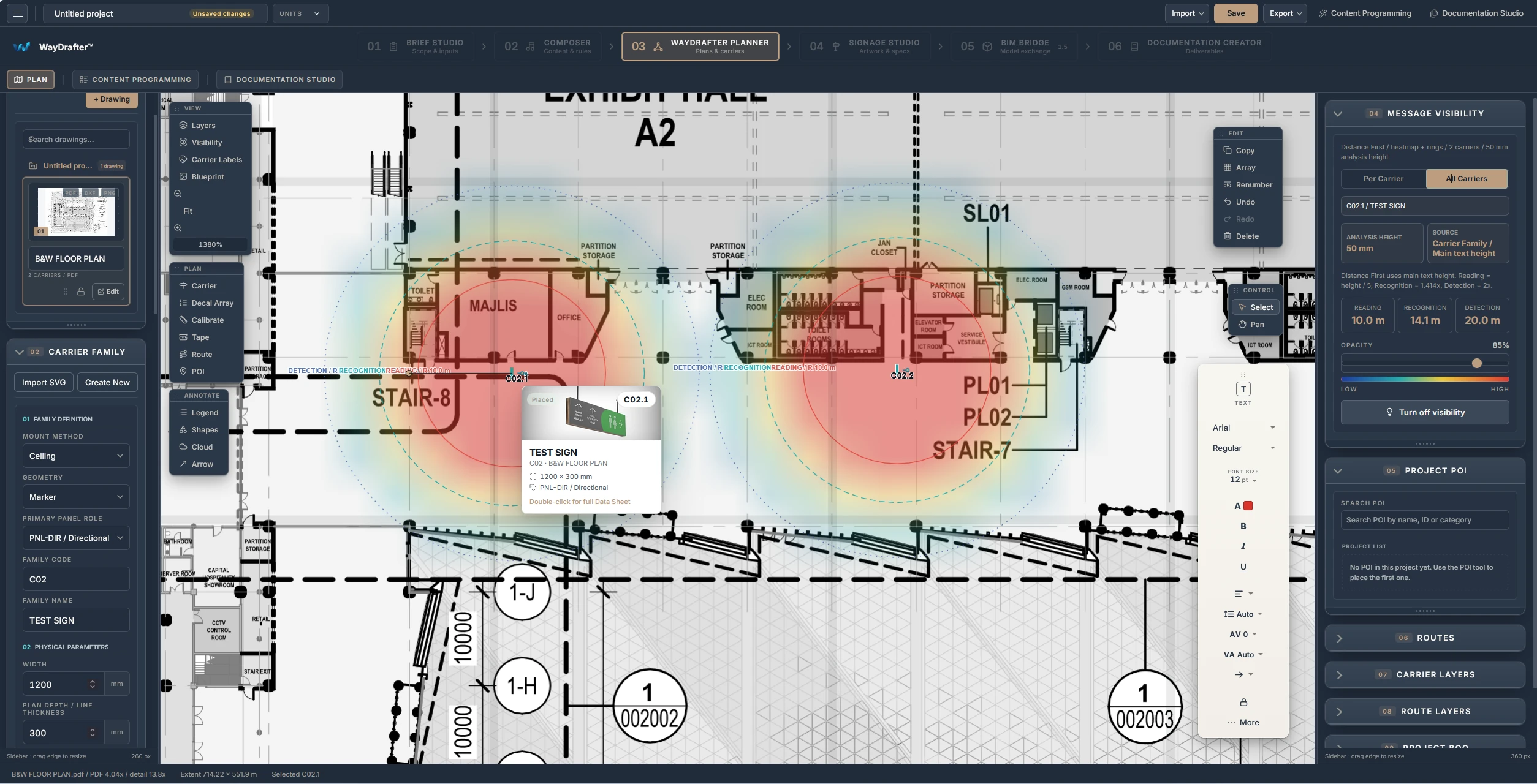
WayDrafter is our internal software environment for designing Signage & Wayfinding systems. It connects spatial analysis, user scenarios, content programming, carrier logic and documentation control into one structured process — reducing repetitive work, limiting coordination errors and keeping design decisions, sign locations, message content and final documentation consistent.
- 01Spatial logic organised as data
- 02Algorithmic control of consistency
- 03Documentation connected to decisions
Fields of signage & wayfinding.
Project types where this discipline drives spatial outcomes.
- 01Urban Spaces
- 02Commercial Buildings
- 03Infrastructure Objects
- 04Office Buildings
- 05Landscape Objects
- 06Horeca Objects
- 07Parks and Green Areas
- 08Heritage Objects
- 09Sport Facilities
- 10Culture Objects & Museums
Design Path — eleven deliverables, three gates.
An ordered, BIM-coordinated process from analysis to implementation support.
The design path runs on an information path.
Signage & Wayfinding BIM in eight steps and three gates — from information requirements to the as-built model, structured on ISO 19650 and openBIM.
What clients receive.
Implementation-ready outputs, structured for tender, production and site.
Selected related project experience.
Projects where this expertise contributed to the spatial outcome.
Darin Castle, Tarout Island
Tarout, Saudi Arabia · Exterior Signage & Wayfinding
Terra Riyadh
Riyadh, Saudi Arabia · Mixed-use Signage & Wayfinding
RCRC Headquarters
Diplomatic Quarter, Riyadh, Saudi Arabia · Interior Signage & Wayfinding
The Pulse Riyadh
Riyadh, Saudi Arabia · Mixed-use Signage & Wayfinding
Concept Samples
Across our projects · Concept & design studies
Frequently asked.
Common questions about scope, deliverables and coordination.
— 01What is included in a Signage and Wayfinding strategy?+
— 02Do you provide BIM-ready signage documentation?+
— 03Do you handle bilingual EN / AR and heritage-context signage?+
— 04What does the client receive at handover?+
— 05Do you design to signage and accessibility standards?+
— 06Do you use AI in wayfinding?+
Signage & Wayfinding, explained.
Wayfinding is decision architecture — routes before signs, decisions before deliverables.
Evergreen guides on choosing a signage & wayfinding consultant, how signage differs from wayfinding, and when a project needs a BIM-led signage workflow — the thinking behind how we design.
Read the Knowledge GuidelinesTell us about your project.
Send over your brief, drawings or an early idea. A partner reads it personally and comes back with first thoughts: the scope that makes sense, the risks we see and what we would do first.
Send RFP